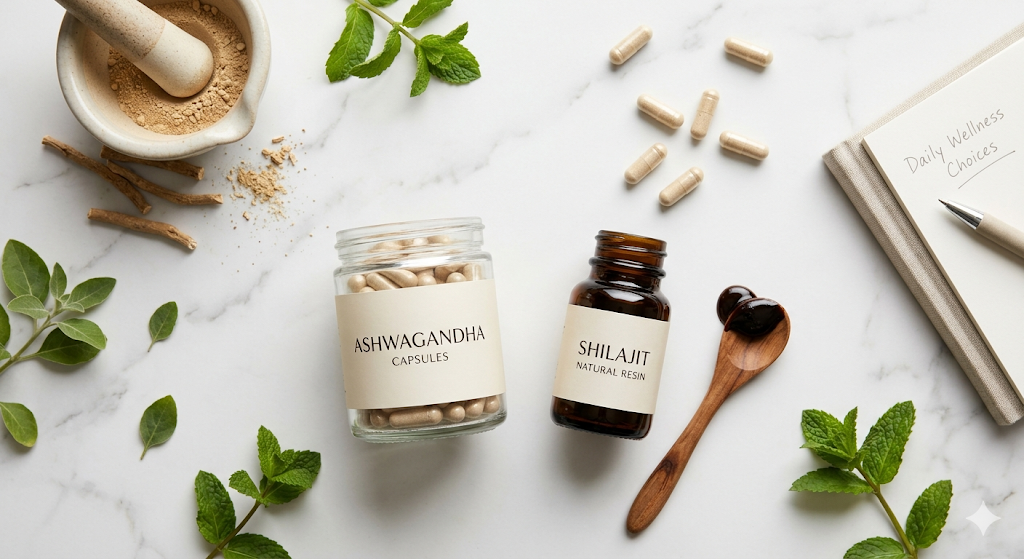
“Should I take Shilajit or Ashwagandha?” I hear this question at least twice a week. Both are ancient Ayurvedic adaptogens. Both claim to boost energy, support hormones, and improve performance. But they work in fundamentally different ways and the research behind each one is not equal. After reviewing the clinical evidence on both, here’s my …

“Should I take Shilajit or Ashwagandha?” I hear this question at least twice a week. Both are ancient Ayurvedic adaptogens. Both claim to boost energy, support hormones, and improve performance. But they work in fundamentally different ways and the research behind each one is not equal. After reviewing the clinical evidence on both, here’s my honest breakdown.
What Are Shilajit and Ashwagandha?
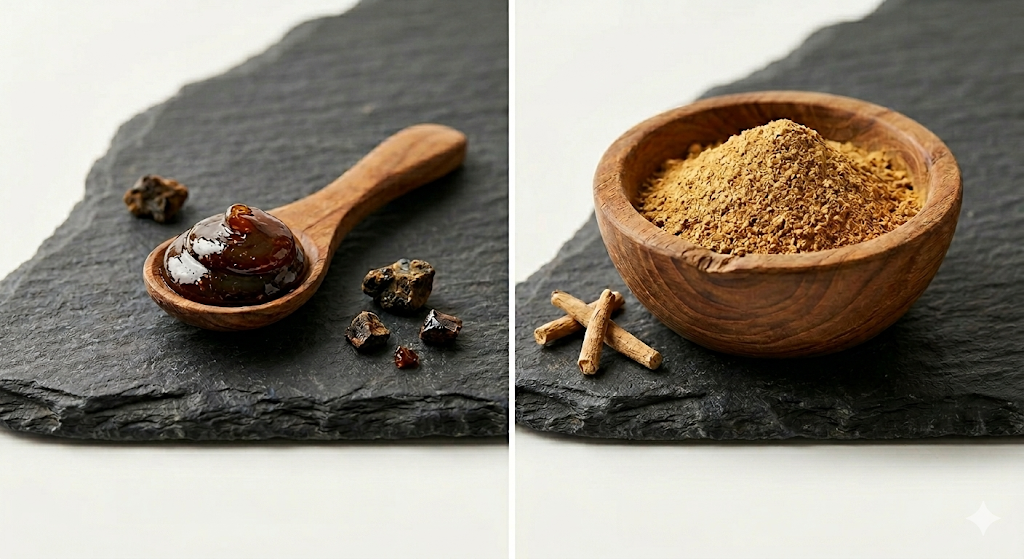
Shilajit is a dark, mineral-rich resin that seeps from Himalayan rock formations. Its primary active compound is fulvic acid, which acts as a nutrient transporter and antioxidant. It also contains dibenzo-α-pyrones (DBPs) that support mitochondrial energy production.
Ashwagandha (Withania somnifera) is a root herb, often called “Indian ginseng.” Its active compounds are withanolides, which modulate the stress-response (HPA) axis, lower cortisol, and influence GABA receptors. The most studied extract is KSM-66, backed by over 24 clinical trials.
Both are classified as “Rasayana” (rejuvenators) in Ayurveda. But they target different systems: Ashwagandha works top-down on your neuroendocrine system. Shilajit works bottom-up at the cellular and mitochondrial level.

1. For Stress and Anxiety: Ashwagandha Wins Clearly
This is Ashwagandha’s strongest domain. A landmark 2012 study by Chandrasekhar et al. gave 64 chronically stressed adults 600 mg/day of KSM-66 for 60 days. The result: a 28% reduction in serum cortisol and a 69% improvement in stress scores versus placebo. Multiple studies have since replicated this.
Shilajit has no human clinical data on stress or cortisol. If anxiety, chronic stress, or HPA axis dysfunction is your primary concern, Ashwagandha is the evidence-backed choice.
2. For Testosterone: Both Work, Different Mechanisms
Ashwagandha: A 2013 KSM-66 trial in oligospermic men showed a 17% testosterone increase plus a 167% rise in sperm count. A 2022 study in healthy men confirmed significant testosterone elevation at 600 mg/day over 8 weeks.
Shilajit: Pandit et al. (2016) found a 20% increase in total testosterone and 19% in free testosterone in 75 healthy men aged 45–55 taking 500 mg/day for 90 days.
In my view, both are genuinely effective here. Ashwagandha has more trials and larger sample sizes. Shilajit showed a slightly higher percentage increase in the one strong study we have. If testosterone is your sole goal, either work or consider both.
3. For Sleep: Ashwagandha, No Contest
Multiple trials confirm Ashwagandha improves sleep. Langade et al. (2019) showed KSM-66 improved sleep efficiency from 75.6% to 83.5% in insomnia patients. A 2020 study of 150 subjects found a 72% improvement in sleep quality versus 29% with placebo.
Shilajit has no sleep-specific data. If sleep is a priority, Ashwagandha is the clear choice. I often recommend it to patients who want a natural alternative to melatonin.
4. For Collagen, Bones, and Connective Tissue: Shilajit Wins
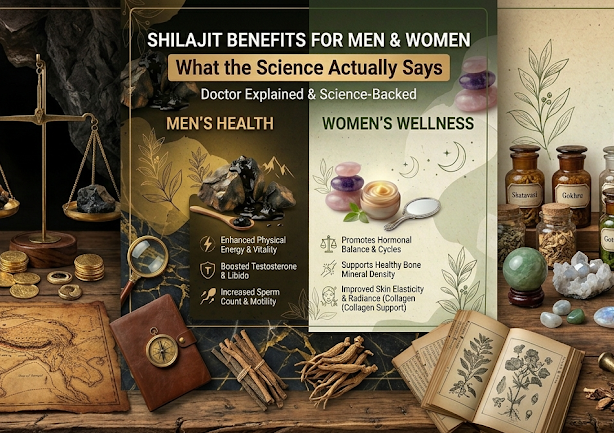
This is where Shilajit occupies territory Ashwagandha simply doesn’t touch. A 2024 trial showed Shilajit increased a type 1 collagen biomarker by up to 165% at 1000 mg/day. A 48-week study in postmenopausal women found it preserved bone mineral density while placebo declined. And a transcriptomic study found Shilajit upregulated 17 genes related to collagen, elastin, and tissue repair in skeletal muscle.
Ashwagandha has no evidence in any of these domains. For women concerned about bone health or anyone focused on connective tissue and skin, Shilajit is the better option.
5. For Energy and Muscle Performance: Different Strengths
Ashwagandha excels at building muscle. A 2015 KSM-66 study showed significantly greater strength gains with resistance training bench press improved by 46 kg versus 26 kg in the placebo group, with notable body fat reduction.
Shilajit excels at sustaining energy. Its DBPs act as electron carriers in the mitochondrial chain, enhancing ATP production. A 2019 study showed it preserved muscular strength under fatigue significantly better than placebo, and reduced collagen breakdown markers.
What I tell my patients: Ashwagandha is better for building. Shilajit is better for enduring.
6. For Brain Health: Ashwagandha Leads, Shilajit Shows Promise
Ashwagandha has two solid RCTs showing improvements in memory, executive function, and processing speed at 300-600 mg/day of KSM-66. Shilajit’s fulvic acid has shown the ability to inhibit tau protein aggregation (an Alzheimer’s hallmark) in lab studies, and a Phase II trial using a Shilajit-based formulation improved cognitive scores though the effects can’t be attributed to Shilajit alone.
Who Should (and Shouldn’t) Use Each
Choose Ashwagandha if: Stress, anxiety, or high cortisol is your primary concern. You want better sleep. You’re focused on muscle building and strength. You have subclinical hypothyroidism (with medical supervision).
Choose Shilajit if: You want broad-spectrum mineral support. Collagen, bone density, or connective tissue is a priority. You need sustained energy without stimulants. You’re a postmenopausal woman concerned about bone health.
Avoid Ashwagandha if: You have liver disease (rare but documented hepatotoxicity cases exist), hyperthyroidism, autoimmune conditions, or are pregnant. Denmark has banned it in supplements; France and the EU have issued safety reviews.
Avoid Shilajit if: You’re pregnant or breastfeeding, have hemochromatosis, or are on blood thinners. And never use unpurified Shilajit heavy metal contamination is a real risk.
As always, I recommend discussing any new supplement with your healthcare provider, especially if you’re on medication.

How to Choose Quality Products
For Ashwagandha, look for KSM-66 (root-only extract, 24+ clinical trials, standardized to ≥5% withanolides) or Sensoril (root + leaf, effective at lower doses, better for sleep). Avoid generic/unbranded powder ConsumerLab found only 25% of Ashwagandha supplements passed quality testing.
For Shilajit, choose purified resin with a batch-specific Certificate of Analysis showing heavy metal levels below WHO limits. Look for fulvic acid content clearly listed (15–20% for natural resin) and manufacturing certifications like ISO 22000, GMP, or HACCP.
Key Takeaways
- Ashwagandha has far more clinical evidence (24+ RCTs vs ~5–6 for Shilajit) and is the stronger choice for stress, sleep, muscle building, and anxiety.
- Shilajit uniquely supports collagen synthesis, bone density, mitochondrial energy, and mineral absorption areas Ashwagandha doesn’t cover.
- Both support testosterone at comparable levels through different mechanisms. They’re complementary, not interchangeable.
- Stacking both is supported by Ayurvedic tradition and makes mechanistic sense, though no large human trial has confirmed synergy yet.
- Quality matters enormously for both. Use KSM-66 Ashwagandha and purified, lab-tested Shilajit resin. Avoid generic products.
Frequently Asked Questions
Can I take Shilajit and Ashwagandha together?
Yes. Ayurveda has paired them for centuries, and available research shows no adverse interactions. The combination targets complementary systems Ashwagandha for neuroendocrine support and Shilajit for cellular energy. A reasonable protocol is 600 mg KSM-66 plus 500 mg Shilajit daily, though this specific stack hasn’t been validated in a clinical trial.
Which is better for testosterone?
Both show comparable effects (17–20% increases), but through different pathways. Ashwagandha has more supporting trials. If testosterone is your only goal, either works. Many of my patients take both for broader hormonal support.
Is one safer than the other?
Both are generally safe at standard doses. However, Ashwagandha has documented (though rare) hepatotoxicity cases and has been restricted in Denmark and reviewed by French and EU regulators. Shilajit’s main risk is heavy metal contamination in unpurified products, not the substance itself.
Which is better for women?
Ashwagandha has more women-specific data, two RCTs on sexual health and studies on thyroid support. Shilajit has the strongest evidence for postmenopausal bone density and skin health. For women, the best choice depends on your primary concern.
How long before I notice results?
Ashwagandha’s stress and sleep effects often appear within 2-4 weeks. Shilajit’s energy benefits typically emerge at 4-6 weeks. Testosterone and body composition changes for both require 8-12 weeks minimum.
What’s the difference between KSM-66 and Sensoril?
KSM-66 is a root-only extract with 24+ clinical trials best for testosterone, stress, and strength. Sensoril uses root and leaf, works at lower doses, and may be better for sleep and relaxation. Both are high quality; generic ashwagandha with no named extract is not.

References
- Chandrasekhar K, Kapoor J, Anishetty S. “A prospective, randomized double-blind, placebo-controlled study of safety and efficacy of ashwagandha root extract in reducing stress and anxiety in adults.” Indian J Psychol Med, 2012. PMID: 23439798
- Pandit S, Biswas S, et al. “Clinical evaluation of purified Shilajit on testosterone levels in healthy volunteers.” Andrologia, 2016. PMID: 26395129
- Wankhede S, Langade D, et al. “Examining the effect of Withania somnifera supplementation on muscle strength and recovery.” J Int Soc Sports Nutr, 2015. PMID: 26609282
- Langade D, Kanchi S, et al. “Efficacy and safety of ashwagandha root extract in insomnia and anxiety.” Cureus, 2019. PMID: 31728244
- Pingali U, Nutalapati C. “Shilajit extract reduces oxidative stress and preserves bone mineral density in postmenopausal women.” Phytomedicine, 2022. PMID: 35933897
- Keller JL, Housh TJ, et al. “Effects of Shilajit supplementation on fatigue-induced decreases in muscular strength.” J Int Soc Sports Nutr, 2019. PMID: 30728074
- Björnsson HK, et al. “Ashwagandha-induced liver injury: A case series from Iceland and the US DILIN.” Liver Int, 2020. PMID: 31991029
- NIH Office of Dietary Supplements — “Ashwagandha: Is It Helpful for Stress, Anxiety, or Sleep?” ods.od.nih.gov